You’ve finally found the perfect sofa.
The colour is gorgeous, the fabric feels lovely, and it looks just right in your living room.
Then one day, disaster strikes.
A cup of tea gets knocked over. Someone drops a little chocolate. Or you notice a mysterious mark on the armrest that definitely wasn’t there last week.
Nobody knows anything about it, of course!
And suddenly you’re staring at your beautiful sofa thinking…
“Can this actually be cleaned without ruining the fabric?”
It’s a perfectly sensible question, especially when you’ve spent good money on furniture you want to look after.
Yes, some velvet and delicate fabric sofas can be professionally cleaned, but the safest method depends on the material, its construction and its condition.
Certain fabrics are particularly sensitive to moisture, heat or rubbing, and some may not be suitable for cleaning at all.
The good news is that you don’t need to be a fabric expert to understand the risks.
Let’s look at what makes these sofas different, what can go wrong and how to protect that lovely furniture of yours.
Why are some sofa fabrics more delicate than others?
Not all sofas are created equal.
Some are designed to cope with busy family life, pets and everyday use.
Others are made using materials chosen for their beautiful appearance and luxurious feel.
And while those fabrics can look absolutely stunning, they sometimes need a little more attention.
The main differences are how the fibres respond to moisture, heat, cleaning products and movement.
Some materials absorb water easily.
Others can change shape when wet or develop visible marks as they dry.
Certain fabrics can also lose colour or become damaged if you rub them too hard.
The filling and backing underneath the fabric matter too.
A sofa has several layers, so what happens on the surface isn’t always the whole story.
And that’s why a cleaning method that works perfectly on one sofa may be completely unsuitable for another.
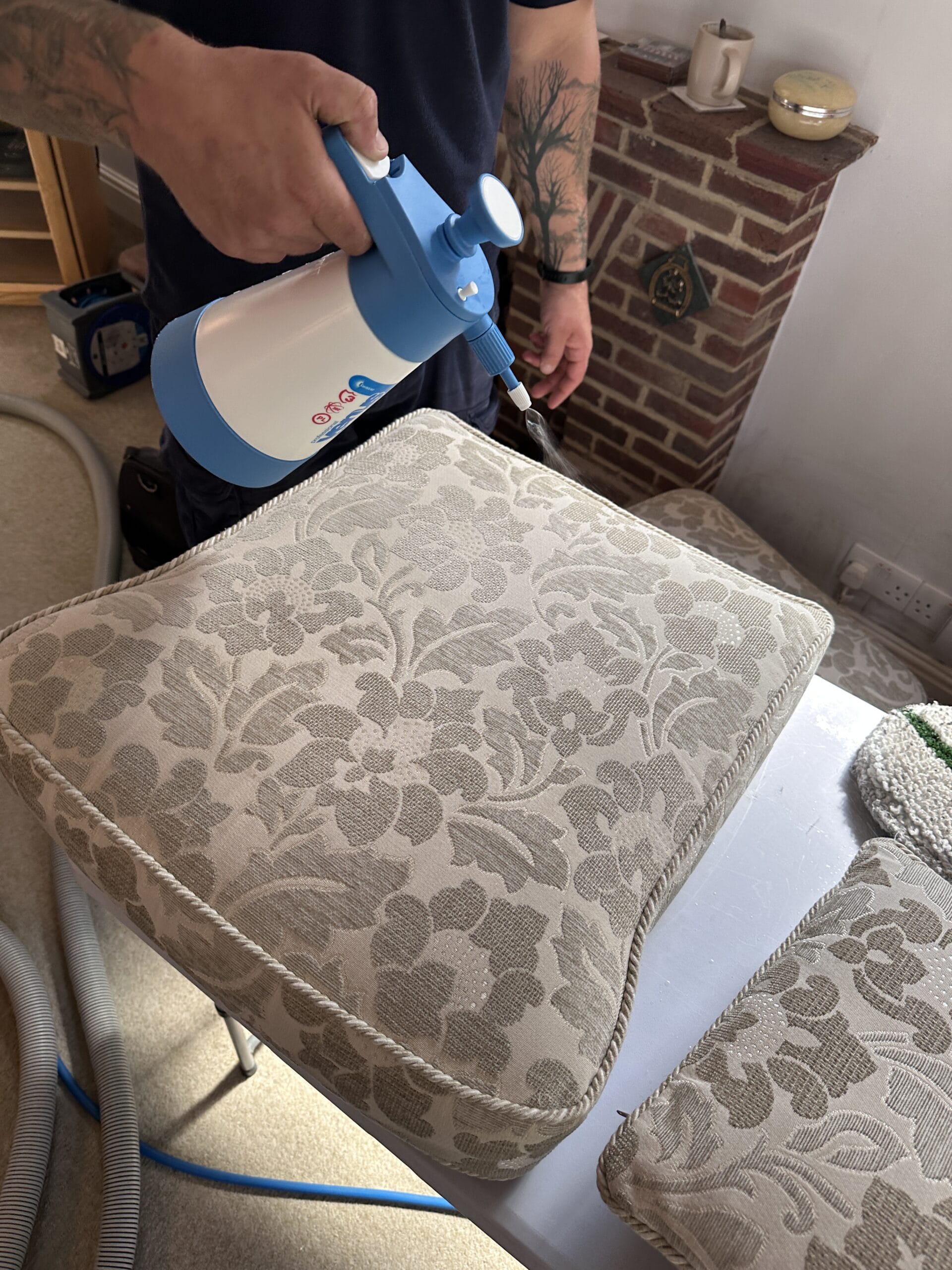
Can velvet sofas be professionally cleaned?
Ah, velvet.
Beautiful, soft and rather good at making a living room look lovely.
Until someone spills a drink on it.
Then suddenly that gorgeous sofa becomes the most stressful piece of furniture in the house!
Some velvet sofas can be professionally cleaned, but others require specialist methods or may be unsuitable for wet cleaning.
The important thing is understanding what the velvet is made from.
Velvet describes the way the fabric is constructed. It has a soft, raised surface made from closely packed fibres, often called the pile.
That raised surface creates the lovely feel and appearance.
However, the pile can sometimes flatten, become distorted or change direction.
This affects how light reflects from the fabric.
The result may be a patch that looks darker, lighter or shinier than the surrounding area.
And frustratingly, that doesn’t always mean the fabric is dirty.
Why does velvet sometimes look marked even when it’s clean?
Have you ever run your hand across a velvet cushion and noticed the colour appear to change?
That’s because the pile direction affects how the fabric reflects light.
This is a normal characteristic of many velvet fabrics.
But pressure, rubbing, and moisture can sometimes leave changes that don’t easily return to normal.
A dark patch on velvet isn’t automatically a stain that needs cleaning.
It could be a pressure mark or an area where the pile has changed.
That’s why recognising the difference matters.
Scrubbing away a mark that isn’t actually dirt could make the situation worse.
Which delicate sofa fabrics need extra care?
Several materials deserve a cautious approach.
Some can look very similar, which makes choosing a cleaning product tricky.
Here’s a simple comparison.
| Fabric | What makes it delicate? | Main cleaning concern |
| Polyester velvet | Raised surface can flatten or change appearance | Pile distortion and visible pressure marks |
| Cotton velvet | May absorb moisture and react to cleaning | Water marks, shrinkage and texture changes |
| Viscose or rayon velvet | Particularly sensitive to moisture | Permanent marks, distortion or colour changes |
| Linen | Some constructions are prone to moisture-related changes | Shrinkage, rings or uneven drying |
| Silk upholstery | Delicate fibres and potentially sensitive dyes | Colour movement, water marks and damage |
| Delicate cotton blends | Cleaning suitability varies with construction | Shrinkage, discolouration or water marks |
This table is a guide, not permission to clean a particular fabric.
The manufacturer’s instructions and the sofa’s actual condition matter more than the fabric name alone.
For example, a synthetic velvet may respond very differently from velvet containing viscose.
Two sofas that look almost identical may need completely different treatment.
Can steam cleaning damage a velvet sofa?
This is one of the biggest questions people ask.
The answer is that steam cleaning isn’t suitable for every velvet sofa.
The word steam cleaning is often used to describe professional hot water extraction, where a cleaning solution is applied and then extracted from the upholstery.
However, different cleaning processes use different amounts of moisture and heat.
Some velvet fabrics may tolerate a carefully controlled water-based process.
Others can develop marks, shrink, or change texture.
Using too much moisture can also affect the materials underneath the visible upholstery.
The safest approach is to identify the fabric and check its cleaning instructions before choosing a method.
Never assume that because a cleaner has a powerful machine, you should automatically use it on your sofa.
A good cleaning decision starts with the furniture, not the equipment.
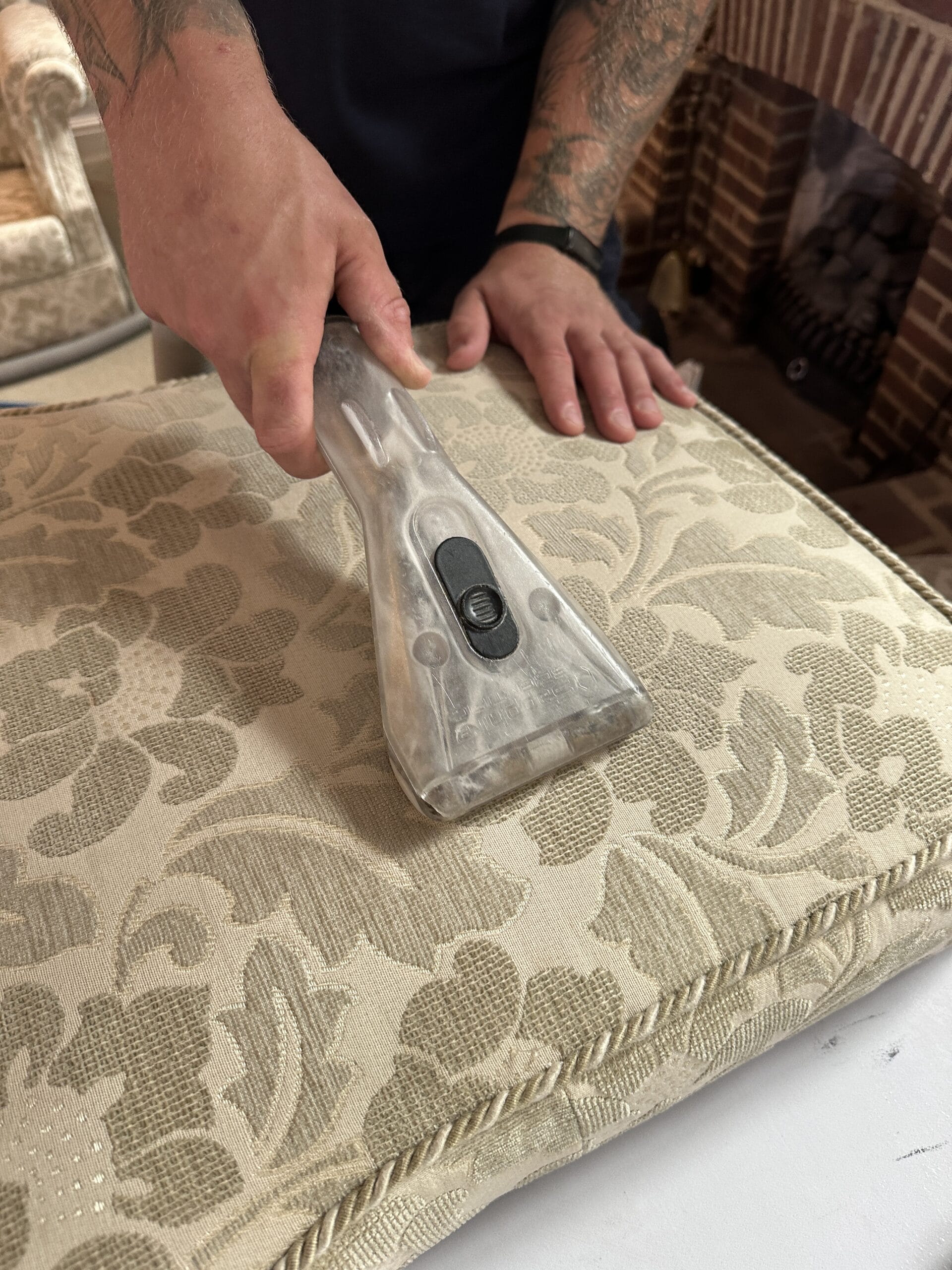
Can plain water leave marks on a delicate sofa?
Now, this surprises quite a few people.
You’d naturally think that a little water would be harmless.
After all, it’s only water!
But on certain fabrics, even plain water can leave a visible mark.
As moisture spreads and dries, it may move existing dirt or residues through the material.
Some fibres can also change their appearance when wet.
The result may be a ring, a darker patch or an uneven area.
Water marks are particularly frustrating because adding more water doesn’t necessarily remove them.
In fact, it may make the affected area larger.
We’ve written a separate guide explaining why water marks on sofas can be so difficult to remove.
It’s worth reading before trying to tackle a mark on delicate upholstery.
What does the cleaning label on your sofa mean?
Here’s something that can save a lot of worry.
Before using anything on your sofa, check the manufacturer’s care label.
It may be underneath the furniture, attached to a cushion or included in the paperwork supplied when you bought it.
Some manufacturers use letters to indicate which general types of cleaning products may be suitable.
| Care code | What it generally means |
| W | Water-based cleaning products may be suitable |
| S | Solvent-based cleaning only, avoid water-based treatment |
| W/S or S/W | Either type may be suitable, subject to other instructions |
| X | Vacuuming or gentle brushing only, no liquid cleaning products |
These codes are a starting point, not a guarantee that every cleaning method is safe.
For example, a W code doesn’t automatically mean the sofa can be soaked, steam cleaned or put in a washing machine.
And not every British sofa uses these letters.
Some manufacturers provide written instructions instead.
If the label is missing or you’re unsure what it means, contact the retailer or manufacturer for guidance.
The fabric supplier Altfield also provides practical fabric care advice, including recommendations for gentle maintenance and caring for pile fabrics such as velvet.
What happens if the wrong cleaning product is used?
We’ve all had that moment.
There’s a little mark on the sofa, you open the cleaning cupboard and spot something that says it removes stubborn stains.
Perfect!
Well, perhaps not.
Household cleaning products aren’t automatically suitable for upholstery.
Kitchen sprays, laundry detergents and general-purpose stain removers may contain ingredients that react badly with certain fabrics.
Possible problems include colour changes, sticky residues, water marks and altered texture.
And rubbing a delicate material can be just as troublesome as using the wrong product.
That beautiful velvet surface may end up looking flattened or shiny.
If you’ve already tried a household cleaner, don’t feel embarrassed.
People are simply trying to look after their homes.
But if the mark hasn’t improved, I’d put the bottle down before trying something stronger.
Our guide on why kitchen cleaners can damage your sofa explains the risks in more detail.
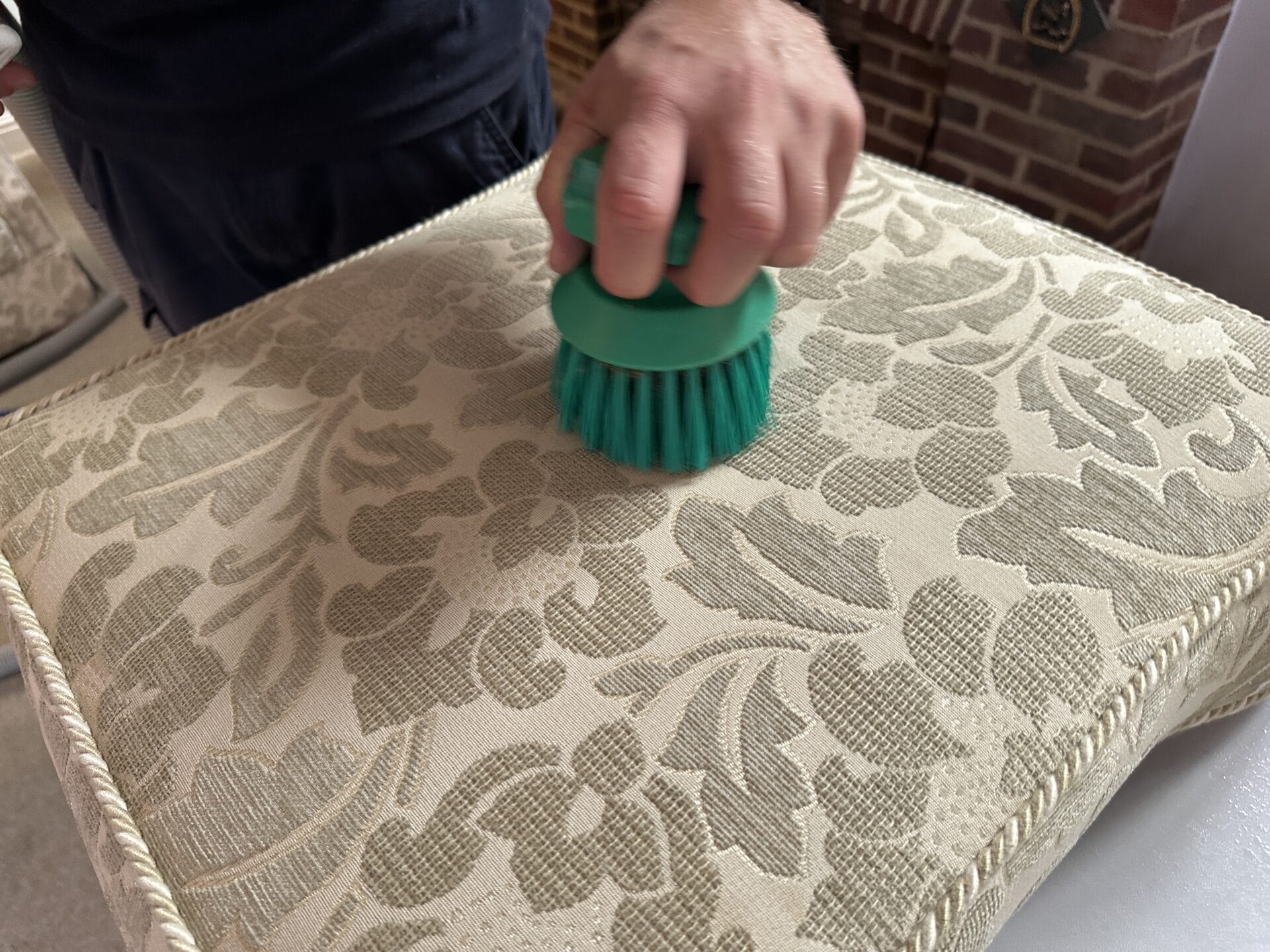
What should you do if something spills on velvet?
First, don’t panic.
And please don’t start scrubbing away as though you’re trying to remove a mark from a kitchen worktop!
The safest immediate response depends on the fabric and the manufacturer’s instructions.
If a liquid spill is sitting on the surface, carefully lift excess moisture with a clean, white absorbent cloth, provided the care guidance allows it.
Use gentle pressure rather than rubbing.
Avoid adding water, detergent or stain remover unless you’re certain the manufacturer permits it.
For very delicate materials, it’s often safer to leave further treatment to someone who understands the fabric.
If you’re concerned about a fresh spill, take a photograph and make a note of what happened.
Even knowing whether the drink contained milk, sugar, or colouring can be helpful.
And if the sofa is a particularly valuable piece, I’d recommend getting advice before experimenting.
A small stain is frustrating. A much larger damaged patch is considerably more upsetting.
What about old stains on delicate fabric sofas?
This is where realistic expectations matter most.
Some old stains can still be improved.
Others may have caused permanent changes to the fabric or its colour.
The age of the stain, what caused it, and anything previously used on it all affect the outcome.
Delicate fabrics can make treatment more difficult because there may be limits on the products and methods that can safely be used.
Sometimes further stain treatment would create more risk than the original mark.
And that’s when the sensible decision may be to stop.
It can be disappointing to hear, particularly when you’ve been staring at that stain for months.
But preserving the rest of a beautiful sofa is often more important than chasing a mark that may not come out.
Can professional cleaning still damage a delicate sofa?
Yes, there can still be risks, even with professional treatment.
A careful cleaner can assess the material, carry out appropriate tests and choose a suitable method, but testing cannot remove every possible risk.
Some fabrics have weaknesses or existing changes that aren’t obvious until treatment begins.
Colour movement, water marks, shrinkage and changes to texture are all considerations.
This is particularly relevant for older furniture, natural fibres and delicate velvet.
Professional assessment helps reduce risk, but nobody should promise that every fabric can be cleaned without any possibility of damage.
At Careclean Essex, understanding what is safe for the upholstery comes before deciding how to clean it.
We’ve explained this further in Can a Sofa Be Deep Cleaned Without Damage?.
Sometimes the most responsible advice is that a sofa needs a specialist method, or that cleaning shouldn’t go ahead.
How can you look after a velvet sofa between cleans?
Now for some good news.
There are several simple things you can do to help look after delicate upholstery without reaching for a cupboard full of cleaning products.
Gentle maintenance is usually the best place to start.
If the manufacturer allows it, use a suitable soft upholstery attachment to remove loose dust.
Avoid dragging hard vacuum attachments across the fabric.
For velvet, some manufacturers recommend careful brushing in the direction of the pile, but only where the care instructions permit it.
Try to protect the sofa from prolonged direct sunlight, which can contribute to fading.
If cushions are designed to be turned or rotated, following the manufacturer’s guidance may help distribute everyday use.
And keep an eye on favourite sitting spots where pressure and wear are most noticeable.
A little regular attention can be much easier than dealing with a difficult stain later.
You can find more practical advice in our guide to maintaining upholstery between professional cleans.
No complicated routine required.
Just a little care for the furniture you’ve chosen.
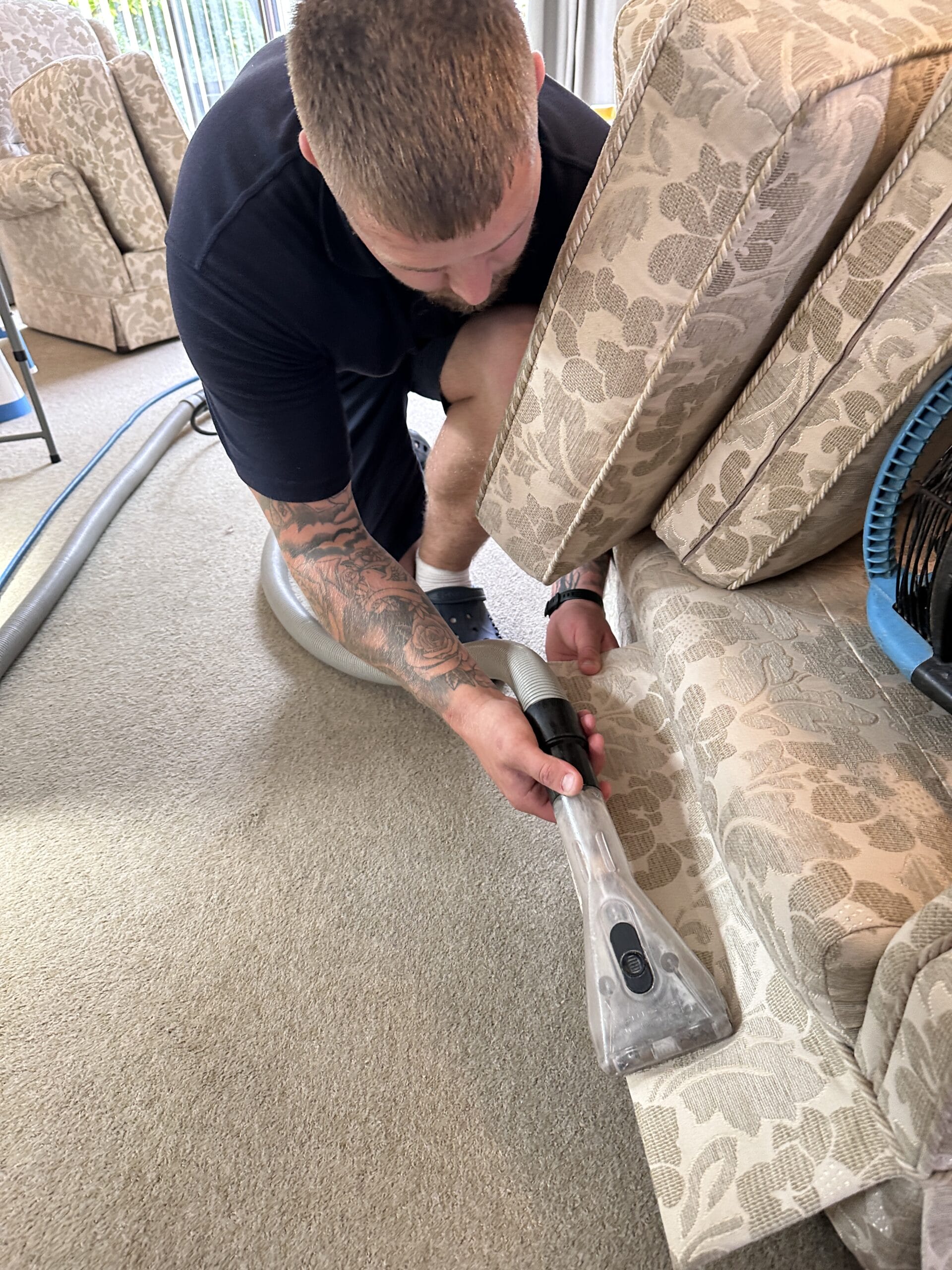
What should you ask before booking velvet sofa cleaning?
If you’re worried about cleaning damage, it’s worth asking a few questions before agreeing to any work.
You don’t need to understand all the technical details.
A good cleaner should be happy to explain what matters.
Here are some useful questions:
- Can you identify the fabric and check its cleaning instructions?
- Is my particular velvet or delicate fabric suitable for your cleaning method?
- Will you carry out appropriate testing before treatment?
- Could the fabric develop water marks, shrinkage or texture changes?
- What results are realistic for the stains I’m concerned about?
- What happens if testing suggests cleaning is too risky?
And if you’re comparing quotations, ask what’s included, how surrounding furniture will be protected and what drying or aftercare arrangements are needed.
The right choice is the one that leaves you informed and comfortable with the risks.
You should never feel pressured to agree to a treatment you don’t understand.
Your beautiful sofa deserves a little care.
Having a velvet or delicate fabric sofa shouldn’t mean living in fear of every cup of tea.
Although perhaps we should all be a little more careful with red wine on cream velvet!
The important thing is understanding what your furniture is made from and treating it accordingly.
Some delicate sofas can be cleaned successfully. Others need a specialist approach, and some are safest left untreated.
Knowing the difference helps protect the furniture you love.
If you’re unsure whether your velvet or delicate fabric sofa can be professionally cleaned, Careclean Essex is happy to discuss your concerns.
Send us a photograph of the sofa, a close-up of the material and the manufacturer’s care label if you have it.
Tell us what’s bothering you, whether it’s a stain, general dirt or a change in the fabric’s appearance.
We’ll help you understand whether an assessment would be worthwhile and what options may be suitable.
No pressure and no promises of miracles.
Just careful advice about a sofa you’d quite understandably rather keep looking lovely.
Frequently asked questions about velvet sofa cleaning.
-
Can velvet sofas be professionally cleaned?
Yes, some can.
Suitability depends on the type of velvet, the fibres used, the upholstery construction and the manufacturer’s care instructions.
Certain materials may require specialist cleaning or be unsuitable for wet treatment.
-
Is steam cleaning safe for velvet?
Not always. Some velvet fabrics are sensitive to heat and moisture.
Professional hot water extraction may be suitable for certain materials, but others need a different approach.
-
Can you clean a velvet sofa with water?
Only if the manufacturer’s instructions allow water-based treatment; some velvet materials, particularly those containing viscose or rayon, can be very sensitive to moisture.
-
Why does my velvet sofa have shiny patches?
Shiny areas may be caused by changes in the direction or condition of the fabric’s raised fibres.
Pressure and wear can affect how light reflects from the surface.
Cleaning may not reverse permanent texture changes.
-
Can professional cleaning remove water marks from velvet?
Some marks may improve, but complete removal cannot be guaranteed.
The fabric’s construction, fibre type and cause of the mark all affect the result.
-
Can linen sofas be professionally cleaned?
Some linen upholstery can be professionally cleaned, but linen may be sensitive to moisture, shrinkage and water marks.
The manufacturer’s instructions and fabric construction should be assessed first.
-
Is viscose velvet difficult to clean?
Yes, viscose can be particularly sensitive to moisture.
Wetting may cause changes in texture, strength or appearance, so specialist assessment is important.
-
Can I wash removable velvet sofa covers?
Only if the manufacturer specifically states that machine washing is suitable.
A removable zip cover isn’t automatically washable.
Washing an unsuitable cover can cause shrinkage or changes to the fabric’s appearance.