You love your dog. Of course you do. I LOVE mine… They’re part of the family.
But sometimes, you walk into your living room, take a deep breath and think…
“Oh, dear. That’s definitely the dog!”
And the funny thing is, your dog is probably sitting there looking completely innocent, wondering why you’re making such a fuss.
You’ve hoovered the sofa, opened the windows, washed the blankets, and perhaps even tried a fabric freshener. Yet somehow, that familiar doggy smell keeps coming back.
Sound familiar?… I’ve got you!!
If your sofa still smells of dog after cleaning, it’s usually because oils, dirt, or other residues have settled into the upholstery. In some cases, it may have reached the cushion filling underneath.
The good news is that there are a few simple things you can check before deciding whether your sofa needs professional attention.
Let’s work out what’s causing that pong and what you can realistically do about it.
Why does my sofa smell of dog in the first place?
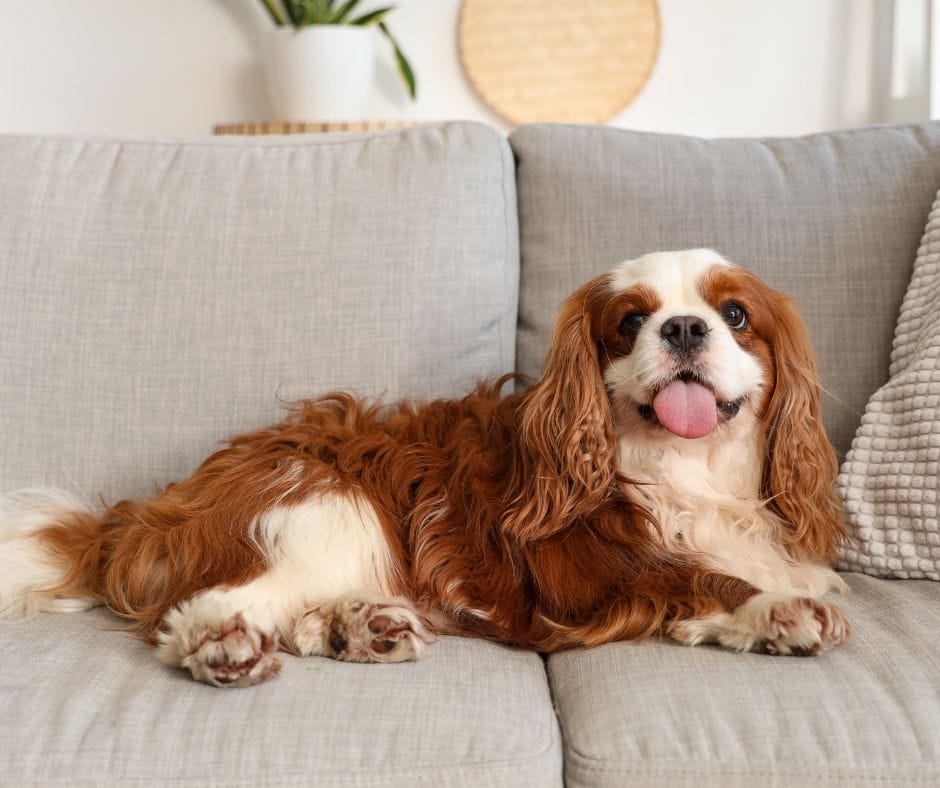
Dogs have a wonderful talent for making themselves comfortable.
They find the softest cushion, claim the warmest corner and somehow take up three quarters of a sofa despite being a quarter of your size.
And while they’re enjoying their favourite spot, they’re leaving little traces of everyday dog life behind.
Natural oils from your dog’s coat
Dogs naturally produce oils that help protect their skin and coat.
When your dog regularly lies against the same part of the sofa, some of those oils can transfer onto the upholstery.
Over time, they mix with dust, loose hair and everyday dirt.
The result can be a lingering doggy smell, even when the sofa looks perfectly clean.
Think about the armrest your dog always leans against, or that one cushion they’ve decided belongs exclusively to them.
Those are often the places worth checking first.
Damp fur after walks
Ah, the great British weather.
One minute it’s lovely sunshine, the next you’re heading home with a dog who looks as though they’ve been swimming in a pond.
And where do they want to go?
Straight onto the sofa, obviously.
When a dog lies on fabric upholstery while damp, moisture and the familiar smell of wet fur can transfer onto the material.
If this happens regularly, particularly in a room with poor ventilation, the upholstery may start smelling musty.
Try to dry your dog thoroughly after wet walks before they settle onto the furniture.
A towel by the back door can be a surprisingly useful little habit.
Hair, dust and everyday dirt
Even the cleanest dogs bring a bit of the outside world home.
Loose hair, dust and tiny particles collect around cushions, seams and the gaps between seats.
These can contribute to that slightly stale smell that develops gradually.
Regular vacuuming helps with this, especially if you use an upholstery attachment suitable for the fabric.
Don’t forget the gaps between the cushions.
You might find enough dog hair to make a second dog in there!
Why does the smell come back after I’ve cleaned the sofa?
This is where things get interesting.
You freshen the sofa, everything smells lovely for a little while, and then a few days later the doggy smell returns.
Frustrating, isn’t it?
There are several possible reasons.
The smell may be deeper than the surface.
Sofas are made from layers of fabric, backing and cushion fillings. Some also have thick foam underneath the upholstery.
If oils or other contamination have worked their way into these layers, removing loose hair from the surface won’t necessarily deal with the source of the smell.
A fabric freshener may only cover the odour temporarily.
It’s rather like spraying perfume over muddy shoes.
You get a lovely fragrance for a little while, but the original smell may still be there.
The dog may be adding fresh oils and dirt to the same spot.
If your dog returns to their favourite corner every afternoon, any improvement may be short-lived unless you also change a few everyday habits.
And that’s an important point.
There’s little benefit in repeatedly treating the sofa if you haven’t worked out what’s causing the smell.
Where is that doggy smell coming from?
Before reaching for another cleaning product, it’s worth doing a little detective work.
No magnifying glass required, although your dog might enjoy supervising.
| What you’ve noticed | Possible cause | What may help |
| Smell strongest on your dog’s favourite cushion | Natural oils and accumulated dirt | Vacuuming, washable throws and suitable upholstery cleaning |
| Smell worse after wet walks | Damp fur transferring moisture | Drying your dog and improving ventilation |
| Sofa smells fresh briefly, then the smell returns | Odour trapped deeper in the upholstery or fresh build-up | Identify the source before further cleaning |
| Strong smell from one particular spot | Previous accident or localised contamination | Professional assessment of the affected area |
| Whole room smells doggy | Dog bedding, rugs and other soft furnishings | Check and clean the other sources too |
| Dog suddenly smells much stronger than usual | Possible coat, skin or ear problem | Ask your vet for advice |
A useful little test: smell the removable throws, check around the cushion seams and compare the dog’s favourite spot with a part of the sofa they rarely use.
You may find that the smell is coming from one particular area rather than the whole sofa.
That makes deciding what to do next much easier.
What can you do to reduce dog smells on your sofa?
Now for the practical part.
You don’t necessarily need to arrange professional cleaning every time your sofa smells a little doggy.
There are some straightforward habits that can help keep the furniture fresher.
Keep on top of loose hair
Vacuuming is one of the simplest ways to prevent hair and loose dirt from building up.
Use the attachment recommended for your upholstery and pay attention to the places where your dog regularly sits.
If the fabric is delicate, always check the sofa manufacturer’s care instructions first.
A gentle, regular clean is usually more useful than waiting until the hair has built up everywhere.
For more everyday tips, we’ve put together a guide on how to maintain upholstery between professional cleans.
Give your dog a washable favourite spot.
Now, I’m not suggesting you tell your dog they’re banned from the sofa.
I know how that conversation would go in some households!
You tell them no. They look at you with those big eyes. Five minutes later, they’re back on the cushion.
A washable throw can be a useful compromise.
Choose one suitable for your dog’s needs and wash it according to the care label.
It’s much easier to wash a throw regularly than deal with oils and dirt building up directly on your sofa.
Just make sure the throw is fully dry before putting it back.
Give the dog a little attention too.
Regular grooming helps remove loose hair and dirt from your dog’s coat before they end up on the furniture.
The animal charity Blue Cross has a helpful guide to grooming your dog, including advice on brushing and different coat types.
And remember, grooming doesn’t always mean bathing.
Different dogs have different needs, so it’s worth following advice appropriate for your dog’s breed and skin condition.
Keep the room ventilated.
Fresh air won’t remove deeply trapped odours from the cushions, but ventilation can help keep the room feeling more pleasant and reduce lingering moisture.
Open windows when practical and ensure damp throws or other fabrics are allowed to dry properly.
Don’t forget the dog bed.
Here’s a sneaky one.
Sometimes the sofa gets all the blame when the real source of the smell is the dog bed sitting beside it.
Check blankets, rugs and bedding too.
Wash removable items according to their care instructions and allow everything to dry thoroughly before your dog uses it again.
You might be pleasantly surprised by how much difference this makes.
Should you spray something on the sofa to remove the smell?
It’s tempting, isn’t it?
You find a bottle that promises a fresh scent, give the cushions a generous spray and hope for the best.
But before you do, it’s worth checking whether the product is suitable for your particular sofa.
Not all upholstery fabrics can safely tolerate water or household cleaning products.
Some materials are vulnerable to staining, discolouration or water marks.
And repeatedly spraying a sofa can introduce moisture without removing the material responsible for the smell.
Products containing strong fragrances or essential oils may also be unsuitable around certain pets.
If you’re unsure about a product, avoid experimenting on your furniture.
A professional assessment is much easier than trying to correct a cleaning product that’s caused additional damage.
What if the smell is actually coming from your dog?
Here’s something that doesn’t always get considered.
Sometimes the sofa isn’t the main problem.
If your dog suddenly develops a particularly strong smell, especially alongside scratching, sore skin or smelly ears, it may be worth speaking to your vet.
A change in smell can sometimes signal a skin or ear problem.
The PDSA explains more about skin problems in dogs and when to seek veterinary advice.
If the odour is coming from your dog’s coat or skin, cleaning the sofa won’t solve the underlying problem.
It’s worth checking before spending money on upholstery cleaning.
And your dog deserves to be comfortable too.
Can professional sofa cleaning remove dog smells?
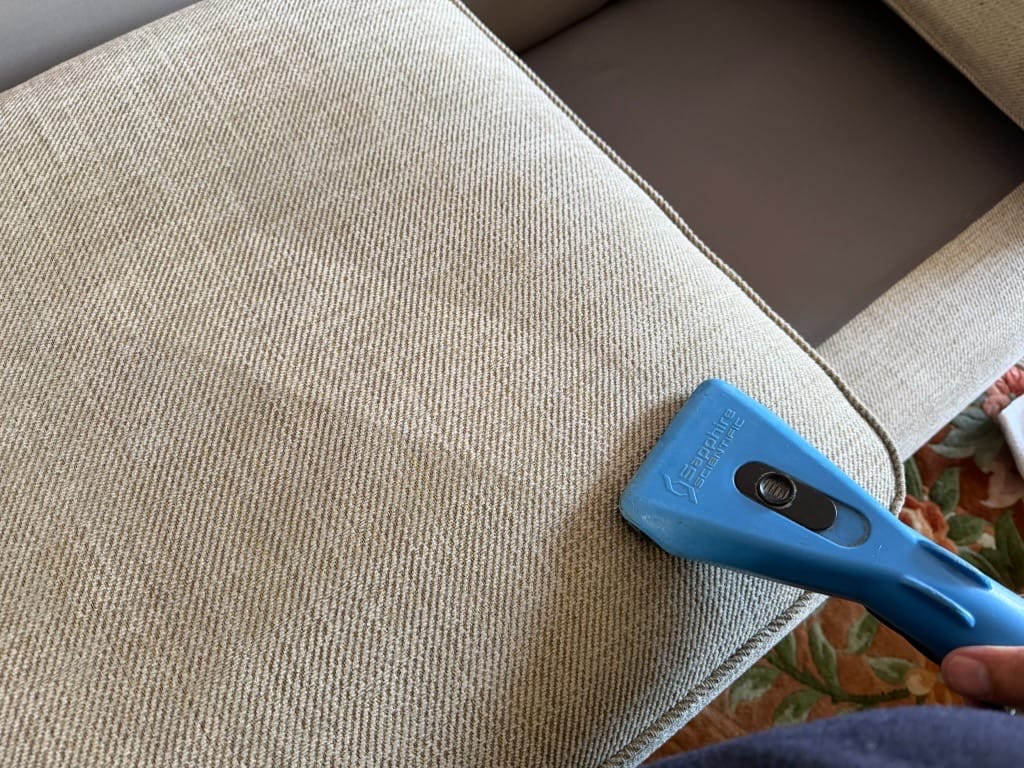
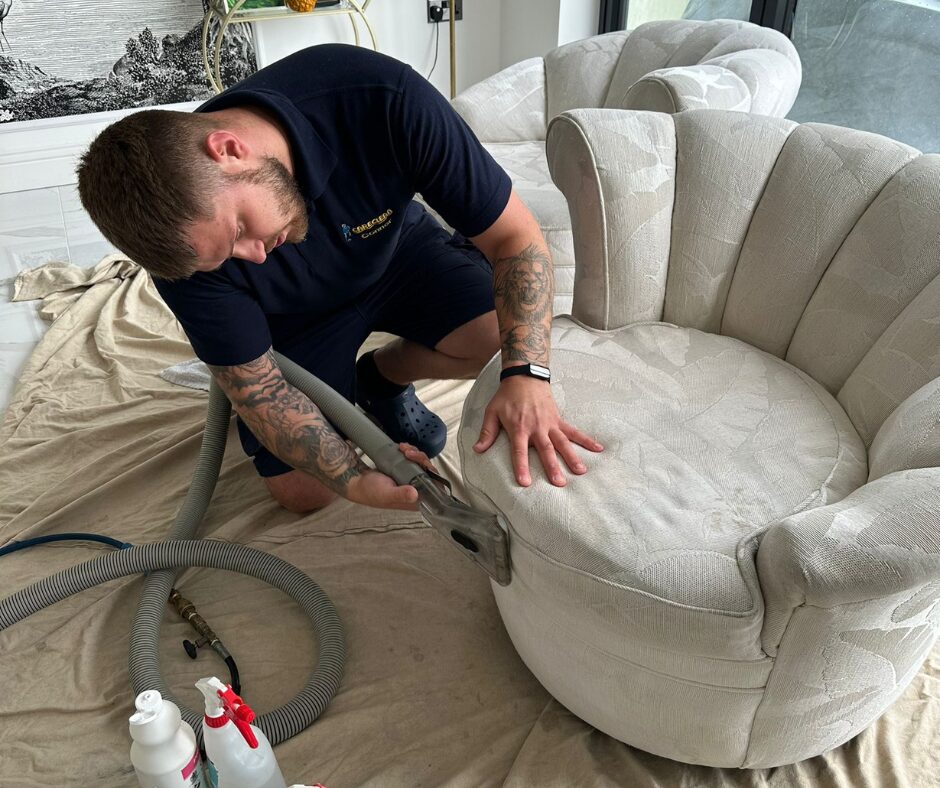
In many cases, professional sofa cleaning can help reduce everyday dog odours.
When the fabric is suitable, cleaning can remove accumulated dirt and oils that ordinary vacuuming cannot fully reach.
However, the result depends on where the smell is coming from and how far any contamination has travelled.
If the problem is mainly in the outer upholstery, professional cleaning may noticeably improve it.
If contamination has reached the inner foam or other parts of the furniture, surface treatment may not be enough.
Some smells can return if their source remains.
It’s also important to consider the material.
Velvet, linen, cotton blends and synthetic fabrics can require different cleaning approaches.
A professional cleaner should assess the sofa before recommending treatment and explain any limitations.
At Careclean Essex, we always believe it’s better to be clear about what’s possible than promise a result without understanding the problem.
If you’d like to know more about the service, you can read about our professional upholstery cleaning in Essex.
What if your dog has had an accident on the sofa?
This is a slightly different situation.
And if it’s happened in your home, don’t panic.
Dogs have accidents for all sorts of reasons. A puppy still learning, an older dog having difficulty or an unexpected illness can all play a part.
There’s no need to feel embarrassed about asking for help.
Urine odours can be more difficult to remove than ordinary dog smells because the liquid may pass through the fabric into the cushion filling.
Even if the visible mark disappears, some contamination may remain underneath.
If an accident has just happened, gently blot up excess liquid with a clean, dry, absorbent cloth, provided this is appropriate for the fabric.
Avoid rubbing or soaking the area with household cleaning products.
If the accident has reached the cushion filling, professional cleaning may be limited, and you may need to consider replacing affected materials.
When asking for advice, tell the cleaner exactly what happened.
That information really does help.
When is it worth having your sofa professionally cleaned?
You don’t need to book a cleaner the moment your dog jumps onto the cushions.
A little everyday dog smell is part of sharing a home with pets.
But sometimes it’s worth getting advice.
For example, if:
- The smell keeps returning, even though you’ve washed the throws and vacuumed carefully.
- One area of the sofa smells noticeably stronger than the rest.
- The fabric looks dull or feels affected by everyday build-up.
- You’re unsure whether you can safely clean the upholstery.
- You’d like an honest opinion on whether cleaning will make a worthwhile difference.
You can start by sending photographs of the sofa and explaining where the smell seems strongest.
Mention any accidents and anything you’ve already used to clean the furniture.
The aim is to understand the situation before deciding what treatment, if any, is appropriate.
How can you keep the sofa fresher afterwards?
If your sofa has been professionally cleaned, a few everyday habits may help maintain the result.
Continue vacuuming with a suitable attachment, wash removable throws regularly and try to avoid letting your dog settle on the upholstery while their coat is wet.
You can also check your dog’s bedding and favourite resting areas so smells aren’t simply being transferred back onto the furniture.
For homes with particularly enthusiastic sofa-loving dogs, a washable cover may be well worth considering.
The aim isn’t to have a perfectly spotless home every minute of the day.
It’s to keep the furniture pleasant to use while still enjoying life with your dog.
Because, let’s face it, the dog is probably going to keep sitting there anyway.
Frequently asked questions about dog smells on sofas
Why does my sofa smell worse when it’s warm?
Warm conditions can make existing odours more noticeable. If oils or other contamination have accumulated in the upholstery, you may become more aware of the smell when the room warms up.
Can I remove dog smell just by hoovering?
Vacuuming can remove loose hair, dust and debris, which may help with mild smells. However, it cannot always remove oils or contamination that have settled deeper into the upholstery.
Will a good old fabric freshener get rid of your dog smell?
A fabric freshener may temporarily change how the sofa smells, but it doesn’t necessarily remove the source. Always check product suitability, particularly if you have pets or delicate upholstery.
Can professional cleaning completely remove dog odours?
Some everyday odours can be substantially reduced or removed. However, complete removal cannot be guaranteed, particularly if contamination has reached the cushion filling.
How often should I clean my sofa if I have a dog?
There isn’t one schedule that suits every household. It depends on how often your dog uses the furniture, the fabric and the amount of dirt and oil building up. Regular vacuuming and washing removable throws can help between professional cleans.
Is a dog smell a reason to replace my sofa?
Not necessarily. If the upholstery is in good condition and the smell is mainly caused by accumulated surface dirt and oils, professional cleaning may be worthwhile. Persistent contamination deep within the furniture can be more difficult to resolve.
Can I use baking soda on a sofa that smells of dog?
Baking soda is often suggested for household odours, but it isn’t suitable for every upholstery material or situation. Powder can remain in seams and cushions, and it won’t necessarily address deeper contamination. Check the manufacturer’s guidance before applying anything.
A little doggy smell doesn’t mean you need a new sofa
Sharing your home with a dog means accepting a few extras.
Muddy paw prints, hair in unexpected places, and occasionally finding your favourite seat has been taken over by someone with four legs.
And honestly, we wouldn’t have it any other way.
But you should still feel comfortable relaxing on your sofa without wondering where that smell is coming from.
Start with the simple things. Check the throws, vacuum the upholstery, make sure your dog is dry after walks and work out whether the smell is coming from one particular area.
If you’ve tried those things and the smell keeps returning, it may be worth asking for some professional advice.
At Careclean Essex, we’re always happy to talk through a sofa cleaning concern.
A couple of photographs and a little information about the furniture can help us understand what you’re dealing with and whether cleaning is likely to help.
No judgement about dogs on sofas. We know who’s really in charge of the living room!