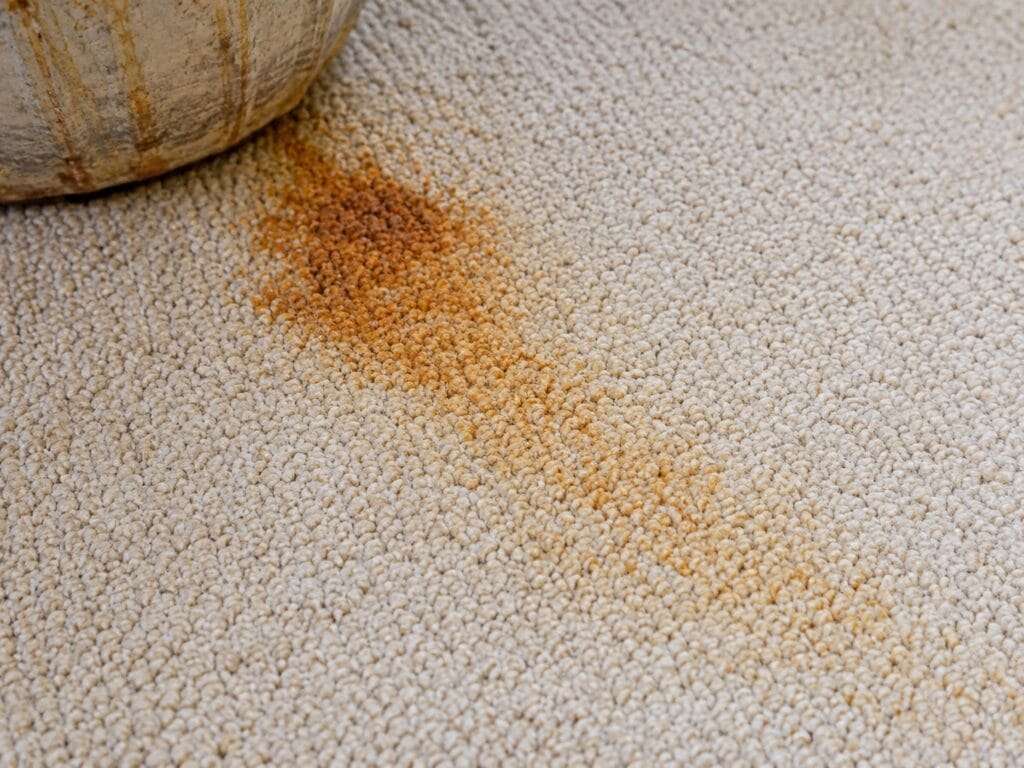
You move a plant pot, shift a chair, or pull something away from the patio doors, and underneath is an orange-brown mark that definitely was not there before.
Rust marks on carpet need a little more care than an ordinary spill. They usually come from metal that has been in contact with moisture, which means the stain behaves differently from tea, mud, or something that has simply been dropped onto the carpet.
The most useful first step is surprisingly simple: stop before reaching for a collection of household cleaning products. Rust can require specialist stain treatment, and using the wrong product first may make the eventual job harder or risk changing the carpet itself.
Why do rust marks appear on carpet?
Rust forms when iron or iron-containing metal reacts with oxygen in the presence of moisture. What you eventually see is the familiar orange or brown discolouration associated with iron oxide.
In a home, you do not need a large amount of water for this to happen.
A small amount of moisture trapped underneath a metal object can be enough.
Plant pots are a common example. Water can escape from the pot or saucer and sit underneath a metal stand or fitting.
The same thing can happen around patio doors where occasional rain or condensation reaches metal furniture.
Furniture feet can also cause it. If a carpet has been cleaned and a metal foot is put back down while the carpet is still damp, moisture and metal can remain in contact long enough for a rust-coloured mark to develop.
That is one reason professional carpet cleaners may place protective tabs or blocks beneath furniture while a carpet finishes drying. You can read more about that in our carpet cleaning aftercare advice.
Is a rust mark just another carpet stain?
It helps to think of rust differently from an ordinary household spill.
Tea, coffee and food stains begin with something being deposited onto the carpet. Rust involves metal oxidation and the resulting iron compounds being transferred onto or into the fibres.
That difference matters because the cleaner you might reach for after a drink has been spilt is not automatically suitable for rust.
Professional textile cleaning standards recognise spot and stain removal as an area where the carpet type, chemistry and condition need to be considered before treatment. The IICRC’s S100 standard, for example, covers cleaning chemistry, carpet fibres and spot and stain removal as part of professional textile floor-covering cleaning.
In practical terms, identifying the stain is part of treating it properly.
It is also why we would rather know that a mark came from a wet metal plant stand, furniture leg or similar object than start treating an unexplained brown patch as if it were dirt.
Where do rust stains on carpet usually come from?
Around the home, there are a few situations we see that make sense once you know moisture is involved.
Under plant pots and stands
A small leak, an overwatered plant, or a damp saucer can go unnoticed because the carpet hides it underneath. If a metal base or stand is involved, you may only discover the mark when you move everything.
Near patio and external doors
Moisture can occasionally reach furniture or fittings near a doorway, particularly during wet weather. Metal sitting against damp carpet creates the conditions in which rust can develop.
Under furniture feet
Metal chair, table or cabinet feet can leave marks if they remain in contact with moisture.
This is worth remembering after carpet cleaning too. At Careclean, protecting the carpet while it dries is part of the wider process, rather than treating drying as an afterthought. Our carpet cleaning service in Essex explains more about how we approach professional carpet care.
Why random household products can be risky
Finding an orange mark usually leads to a quick Google search and a cupboard full of possible answers.
Vinegar. Lemon. Bleach. A general stain remover. Washing-up liquid. Something stronger from underneath the sink.
The difficulty is that you are treating two things at once: the stain and the carpet.
A product capable of reacting with a mineral or metallic stain may also interact with carpet dye or fibre. Carpet construction matters too. Something tolerated by one synthetic carpet may be completely inappropriate for a wool-rich carpet.
Kitchen cleaners can damage carpet fibres and leave residue behind, so a product made for a worktop is not a good substitute for something designed for carpet.
WoolSafe advises testing any spotting agent in an inconspicuous area, using small controlled quantities, avoiding over-wetting and using products intended for carpet. It also advises that old or extensive stains are a sensible point at which to seek professional help. You can read their carpet and rug care guidance.
That is useful advice for rust marks in particular.
More product does not necessarily mean more stain removal.
Repeatedly adding different chemicals can leave you with the original rust mark plus residue, colour change or a much larger damp patch.
If you have already tried cleaning the area and it seems to disappear before returning, our guide to why carpet stains keep coming back explains how moisture, residue and wicking can affect what you see as a carpet dries.
What should you do when you first find a rust mark?
First, remove whatever caused it and keep the area dry.
If a wet plant pot, metal stand or piece of furniture was sitting there, move it away so no more moisture or metal remains in contact with the carpet.
Next, take a proper look at the mark before putting anything on it.
Is it a small orange outline from a furniture foot?
Has moisture spread beyond the visible rust?
Is the carpet wool or a wool blend?
Has anyone already used a cleaning product on it?
Knowing those details can make the next decision much easier.
If you plan to ask a carpet cleaner for advice, a clear photograph before you attempt anything else can be very helpful. It shows the original colour, shape and scale of the problem.
What if you have already tried to clean it?
Don’t panic and don’t keep adding products to cancel out the previous one.
The useful thing now is to stop and note what you’ve already used.
Tell the cleaner whether it was vinegar, a supermarket carpet cleaner, a bleach-based product, washing-up liquid or anything else.
That information matters.
Some marks that become troublesome are no longer a simple case of removing the original substance. The carpet may also hold cleaning residue or show changes caused by the previous treatment.
We cover this in our guide to oil stains on carpet, too. Different stains call for different chemistry, and knowing when to stop is often more useful than trying a fifth household remedy.
Can an old rust mark still be treated?
Age makes stain treatment less predictable, but an old mark is still worth assessing.
The realistic result depends on the carpet, the amount of rust present, previous products used, and whether the original metal source is still causing a problem.
This is where an honest assessment matters.
A professional cleaner should be able to look at the fibre and the condition of the area, establish what has probably caused the mark and explain what is realistic before carrying out treatment.
No responsible cleaner should promise that every rust stain will disappear completely without first seeing what they are dealing with.
For a pale carpet, wool carpet, older stain or a highly visible area, that cautious approach becomes even more important.
How can you stop furniture leaving rust marks after cleaning?
Prevention is much easier than trying to correct a mark afterwards.
Metal furniture feet should not sit directly on damp carpet.
During professional cleaning, you can position small protective blocks or tabs beneath suitable furniture while the carpet dries. They separate the furniture foot from the damp fibres and help prevent furniture stain transfer or rust marks.
If you are moving items yourself after cleaning, leave any protective pieces in position for the period your cleaner recommends.
It is a very small detail, but it can save you discovering four neat orange marks under an otherwise perfectly clean chair.
Rust mark or another type of brown stain?
Colour alone does not always tell you what caused a carpet stain.
A brown or orange patch could come from rust, an old drink spill, soil, furniture transfer or something that has moved upwards from deeper in the carpet while drying.
Context is often the biggest clue.
A circular orange mark underneath a metal plant stand strongly points towards rust.
A brown patch that appears again after cleaning may have a different cause.
If you are not sure, avoid diagnosing the stain purely by colour. Our stain guides, including how to get tea out of carpet, show how differently apparently similar marks can behave once you understand what caused them.
When is it worth calling a professional?
A small rust mark can look deceptively simple.
Professional advice becomes particularly useful when the carpet is wool or wool-rich, the stain has been there for some time, it is in a highly visible position, several cleaning products have already been used, or you simply do not know what the carpet will tolerate.
The aim is to protect the carpet while treating the stain.
That means identifying the likely cause, checking the carpet and choosing the treatment around both.
If you would like reassurance before deciding what to do, you can also see what Careclean clients say about their experience.
We are happy to look at the mark and tell you what looks realistic before you decide.
Frequently asked questions
Can furniture feet cause rust stains on carpet?
Yes. If a metal furniture foot remains in contact with damp carpet, corrosion can lead to an orange or brown rust mark. You can prevent this during carpet drying by keeping susceptible metal feet separated from damp fibres with suitable protective blocks or tabs.
Why is there rust underneath my plant pot?
Moisture may have escaped from the pot or saucer and remained trapped underneath. If a metal stand, base or fitting was also present, the damp conditions can allow the metal to corrode and transfer a rust-coloured mark to the carpet.
Should I put normal carpet stain remover on rust?
It is better to establish what the carpet and stain are before experimenting. Rust behaves differently from many food and drink stains, and WoolSafe recommends using carpet-appropriate products, testing first and avoiding uncontrolled applications of spotting chemicals.
Can rust permanently stain carpet?
Some rust marks can be successfully treated, while others may leave some remaining discolouration. The likely result depends on the carpet fibre, the mark’s severity and age, and anything previously used on it. An inspection gives a much better basis for judging what is realistic.
Why did the stain appear after they cleaned my carpet?
If a metal furniture foot was placed directly onto carpet before it had dried fully, the moisture may have contributed to rust formation or transfer. Protective furniture tabs or blocks are commonly used during drying to prevent this type of problem.
A sensible next step
A rust mark is one of those carpet problems where knowing what not to do can save a lot of trouble.
Move the source, keep the area dry and avoid cycling through household cleaners if you are unsure how the carpet will react.
If you are in Essex and would like us to look at a rust mark, send us a clear photo and tell us what caused it, if you know. We’ll give you a straightforward view of what is worth doing next.